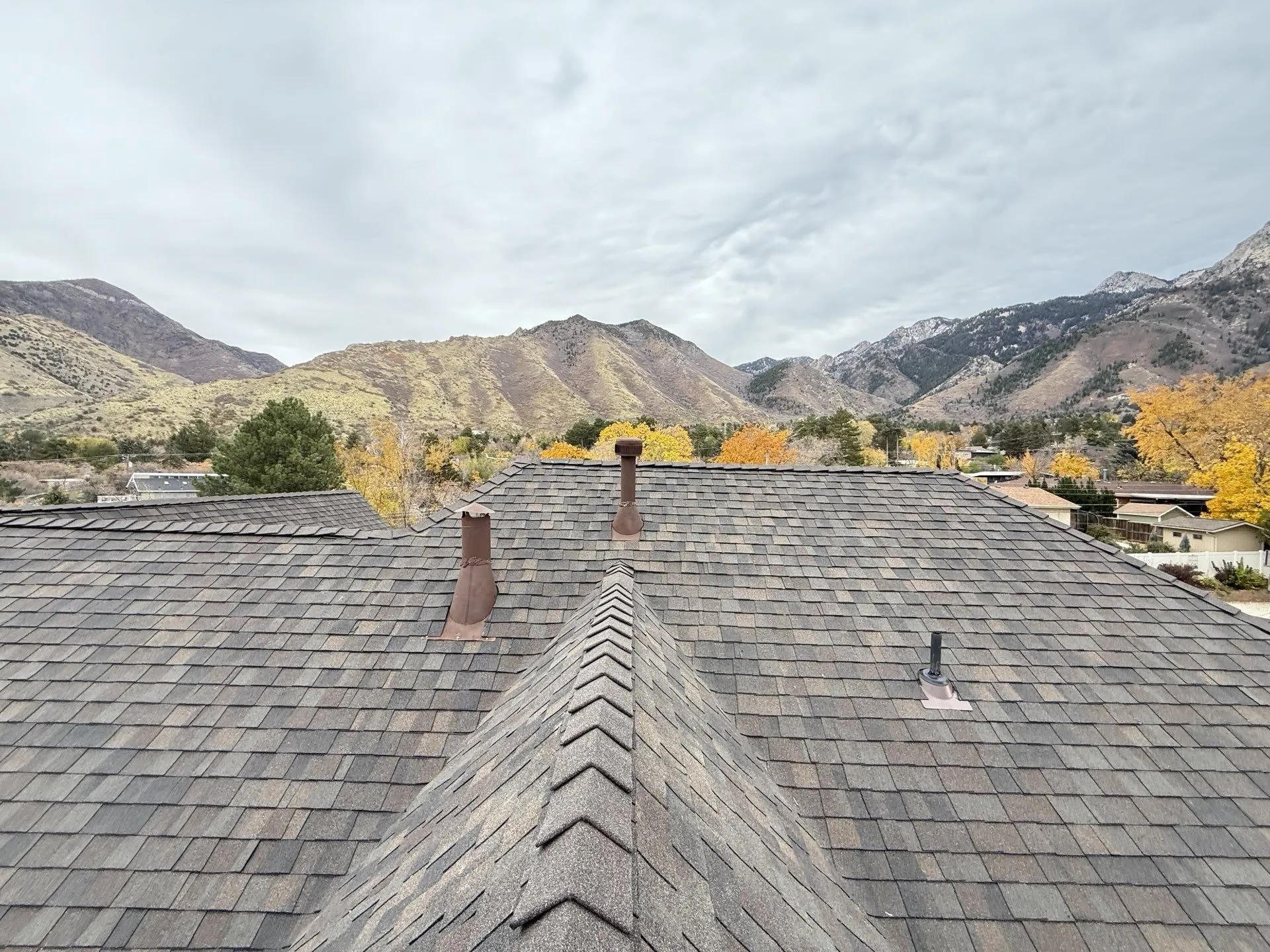
QUICK ANSWER: After a storm in Holladay, document damage with photos within 48 hours, review your policy notice requirements promptly, and get a licensed Utah roofer on-site before any cleanup. Holladay's east-bench position at the mouths of Big Cottonwood and Mill Creek Canyons exposes roofs to outflow winds the National Weather Service Salt Lake City has documented at 60 to 80 mph during frontal passages — strong enough to justify a documented inspection on older asphalt shingles. Frame Restoration Utah is licensed, insured, BBB Accredited, with 24/7 storm response and a 10-year workmanship warranty. Call 435-292-8802.
Why Holladay Storm Damage Hits Differently than Valley Cities
Holladay sits on the Wasatch east bench at roughly 4,300 to 4,800 feet, directly downwind of two of the highest-wind canyon mouths in the Salt Lake metro: Big Cottonwood Canyon at the southern edge of the city and Mill Creek Canyon at the northeastern boundary. When frontal passages hit the Wasatch face, air column physics force the system through these canyon throats and accelerate the wind on its way out. The National Weather Service Salt Lake City office issues distinct wind advisories and warnings for the I-215 / east-bench corridor for exactly this reason — sustained 40 to 50 mph winds with high gusts during spring frontal events and fall outflow.
The valley cities west of Holladay — Murray, Taylorsville, West Valley — see the same frontal systems but at lower wind speeds because they lack the canyon-throat acceleration effect. The same April 2 Wasatch storm that produced 50 mph gusts in West Valley produced 70+ mph gusts in Holladay's Olympus Cove and Cottonwood Hollow neighborhoods. This is why Holladay roofs fail in storms that valley homes shrug off, and why a generic Salt Lake County storm-response playbook under-reads the damage scope on east-bench claims.
The second compounding factor is Holladay's mature tree canopy. Most Holladay neighborhoods were established between 1955 and 1985, which puts their tree cover at 40 to 70 years of growth — significantly more than newer Wasatch Front cities. Heavy wind events translate that canopy into branch-debris loading on roofs: wind-loaded limbs strike shingles, gutters, and ridge caps at impact angles that produce damage profiles closer to hail than to clean-air wind events. After the canyon-outflow wind passes, the inspection scope is wind damage plus impact damage, and can be missed in a rushed inspection the impact component.
Storm Damage Signs Every Holladay Homeowner Should Check
Walk your property perimeter from the ground first — never climb on the roof, especially on the steep custom-home pitches common in Olympus Cove and the Walker Lane area. Look for shingle fragments in the yard or driveway, granule piles at downspout splash blocks, dented soft metals (gutters, mailbox, AC condenser fins, vehicle hoods), and lifted or rotated ridge caps visible from a sidewalk view. On the north and northwest planes — the canyon-outflow downwind sides — you will typically see the heaviest concentration of lifted shingles.
Pay extra attention to branches and limbs on the roof, especially in the older Holladay Village and Walker Lane neighborhoods where mature trees dominate. A branch the size of your forearm hitting a 15-year-old shingle at 50+ mph reads to insurance like a hail impact: cracked seal strips, bruised mat, granule loss in a localized pattern. If you see any limbs on the roof itself, photograph them in place before any cleanup — that documentation is useful evidence for the impact-damage record. Removing debris before photos are taken weakens the condition file.
Inside, scan every ceiling and check the attic with a flashlight for new dark streaks on rafters, wet insulation, daylight visible between sheathing boards, or staining in closet and garage ceilings. Pipe boots — the rubber collars around plumbing vents — fail on a 10-to-12-year cycle and are the single most common failure point after Holladay wind events. Most homes have 2 to 4 of these. Cracked or leaning boots are an open hole in your roof. On 1960s-70s homes in the Walker Lane / Old Mill area, original galvanized boots may still be in place — those corrode faster than rubber and should be replaced on any post-storm scope of work.
What To Do in the First 48 Hours After a Storm
Step one is safety. Stay off the roof. Holladay roof pitches range from modest 5/12 on 1960s ramblers to 10/12+ on Olympus Cove custom homes, and storm-loosened shingles cause more homeowner falls than any other roof activity. If a tree limb is on your roof or you see active leaking, call emergency tarping services immediately — a properly installed temporary tarp prevents tens of thousands of dollars of interior framing and drywall damage during the 5-to-10 days a permanent repair takes to schedule and complete.
Step two is documentation. Photograph every visible damage point from the ground: roof planes, gutters, soft metals, interior stains, and any tree debris on the roof. Note the date, time, and storm conditions. Holladay east-bench storms hit in narrow corridors along the canyon-outflow lines, and a precise timestamp anchors your roof-condition file to a specific NWS-recorded event. Weak documentation makes hail and wind damage harder for a homeowner and carrier to evaluate later.
Step three is calling a Utah-licensed roofer for a documented inspection. Verify licensing at the Utah Division of Professional Licensing — out-of-state storm chasers descend on the Wasatch east bench after every significant wind event, and they may lack proper licensing, insurance, or local accountability when warranty issues surface six months later. Frame Restoration Utah is BBB Accredited and provides this inspection free, with no obligation, whether you decide to file storm-damage documentation or not.
storm-damage documentation for Holladay Storm Damage
Utah policy notice and filing windows are policy-specific. After a Holladay wind or hail event, start the paper trail early: save the storm date, photograph visible damage, and read your policy before assuming a universal deadline.
The documentation process follows a specific sequence: open the roof-condition file with your insurer if you decide to file, photograph everything before any cleanup or repair, get a Utah-licensed contractor's documented inspection, and keep a written construction scope for carrier review. Frame Restoration Utah documents roof conditions and repair scope; coverage decisions stay between you and your insurer. See our complete roof-claim documentation guide for a step-by-step homeowner breakdown.
Holladay-specific factor: while most of the city has no HOA design control, several upscale sub-neighborhoods (Cottonwood Hollow, Old Mill Estates, parts of Walker Lane) carry CC&Rs with material requirements that may exceed what your policy pays as "like-kind-and-quality" replacement. That difference may need HOA documentation and carrier review. Confirm your specific HOA covenant before agreeing to an carrier-reviewed scope. The Holladay Village commercial core (along Holladay Boulevard near 4800 South) also has a design review committee that may apply to mixed-use and certain corner-lot residential properties — verify with the city before locking in materials.
Neighborhood-Specific Storm Considerations
Olympus Cove and Mt Olympus area homeowners face the highest combination of wind exposure and material-spec stakes in the city. The neighborhood sits directly at the Wasatch face and absorbs the strongest canyon-outflow gusts. Many homes here are custom builds from the 1980s-2000s with steeper pitches, complex valleys, and standing-seam metal or designer-shake material specs. Storm-damage repairs need to match the existing material grade — a like-for-like asphalt scope on a standing-seam roof will be rejected by both the homeowner and any sub-neighborhood architectural review. Plan for higher material costs and longer lead times on these specialty products.
Cottonwood Hollow homeowners need to factor in their HOA design covenants before agreeing to an carrier-reviewed scope. The neighborhood's CC&Rs typically require Class A fire-rated materials with 30-year minimum warranties, architectural-grade asphalt at minimum, and certain color and profile restrictions. A standard like-for-like asphalt repair may not satisfy the HOA architectural review board even after carrier review notes the roof-condition file. Frame Restoration Utah handles HOA submittals as part of any Cottonwood Hollow scope — confirm requirements before locking your carrier scope so any material upgrade is documented before homeowner or carrier review.
Walker Lane, Old Mill, and the older 1960s-70s neighborhoods have a different problem: housing-stock age. Many of these homes are on their first or second reroof cycle, with original 1980s-1990s 3-tab asphalt shingles now well past warranty. Same wind event, more documented roof-condition scope than newer homes. Heavy mature tree canopy here also produces the highest branch-impact damage rates in the city. Document granule loss, bruised shingle mats, and any branches on the roof carefully — these older homes often need closer inspection before repair-versus-replacement is clear.
Holladay Village core (along Holladay Boulevard near 4800 South 2300 East) and the historic Old Holladay corridor have informal design-conscious character without a formal historic overlay. The city's design review committee may apply to certain mixed-use and corner-lot properties — verify before scope-locking. For most residential repairs in this corridor, like-for-like clears administratively, but visible material upgrades (color shifts, profile changes, switch from asphalt to metal) can trigger committee review and a 1-to-2 week approval delay. Build that buffer into your repair schedule.
The Frame Restoration Utah Repair Process
Every storm-damage repair starts with a free, no-obligation roof inspection. Our crew documents the full damage scope with annotated photos, measures every plane, and provides a written estimate within 24 to 48 hours. We work to current International Residential Code (IRC R905) standards and Utah DOPL contractor licensing requirements, and every reroof or major repair includes our 10-year workmanship warranty plus the manufacturer's material warranty (typically 30 to 50 years on architectural shingles, 50+ years on standing-seam metal).
For partial repairs, we replace damaged shingles, reseal compromised flashing, install new pipe boots, and reinforce ice-and-water shield in vulnerable areas. Holladay's IRC R905.1.2 minimum is 36 inches of ice-and-water shield extending 3 feet past the interior wall line; on north-facing planes and Olympus Cove homes with steep pitches we typically install full-deck ice-and-water shield as a baseline. For full reroofs, we tear off to the deck, inspect and replace any rotten sheathing, install a complete underlayment system, and apply HOA-compliant materials where required. Full reroof scope details are here.
Throughout the repair we coordinate permit and HOA documentation where applicable, and provide roof-condition documentation the homeowner can share with a carrier when needed. Homeowners remain in control of policy decisions. We schedule around Holladay's east-bench weather windows so your reroof doesn't kick off the day before the next 70-mph canyon outflow comes off the Wasatch — that scheduling discipline is the difference between a local Utah contractor and an out-of-state storm chaser.
Frequently Asked Questions
Why does Holladay get worse storm damage than valley cities like Murray or Taylorsville?
Holladay sits on the Wasatch east bench directly downwind of Big Cottonwood Canyon and Mill Creek Canyon. When frontal systems hit the mountain face, air accelerates through the canyon throats and exits onto the bench at 60 to 80 mph during major events. The valley cities to the west see the same storms but at 20 to 30 mph lower gust speeds because they lack the canyon-throat acceleration. The National Weather Service Salt Lake City office issues distinct wind advisories for the east-bench corridor.
Does my Cottonwood Hollow or Old Mill home need HOA design review for storm-damage roof repair?
Yes. Cottonwood Hollow and Old Mill Estates carry CC&Rs requiring Class A fire-rated materials with 30-year minimum warranties and certain color/profile restrictions. Like-for-like asphalt repairs typically clear administratively, but visible material upgrades need architectural review board approval. The HOA covenant may exceed what your carrier pays as "like-kind-and-quality" — that difference may need HOA documentation and carrier review. Frame Restoration Utah handles HOA submittals as part of any Cottonwood Hollow or Old Mill scope.
What canyon-outflow wind speeds should Holladay homeowners watch for?
NWS Salt Lake City typically issues a Wind Advisory at 30 to 39 mph sustained or 46 to 57 mph gusts, and a High Wind Warning at 40+ mph sustained or 58+ mph gusts. For Holladay's east-bench corridor, gusts above 50 mph are routine during frontal passages, and 70 to 80 mph during major events. Asphalt shingles older than 10 years can show lifted tabs, broken seals, or ridge-cap movement after strong gusts. After any event with sustained 40+ mph winds in the Holladay-Cottonwood Heights-Millcreek corridor, schedule a free roof inspection within 30 days.
Why does Holladay's mature tree canopy increase storm damage?
Most Holladay neighborhoods were established between 1955 and 1985, putting their tree cover at 40 to 70 years of growth — significantly more than newer Wasatch Front cities. Heavy wind translates the canopy into branch-debris loading on roofs. Wind-loaded limbs strike shingles, gutters, and ridge caps at impact angles that produce damage profiles closer to hail than to clean-air wind events. Document any branches found on your roof in place before cleanup — that evidence anchors the impact-damage component of your roof-condition file, which can be missed in a rushed inspection.
How long does storm damage roof repair take in Holladay neighborhoods?
Minor repairs (shingle replacement, flashing reseal, pipe boot replacement) typically complete in 1 to 2 days. Full reroofs run 4 to 7 days for standard Holladay homes and 7 to 10 days for Olympus Cove or Cottonwood Hollow specialty-material reroofs. HOA architectural review for material upgrades adds 1 to 2 weeks. Holladay Village design review for visible exterior changes near the commercial core adds another 1 to 2 weeks. Emergency tarping happens within 24 hours of the call. Frame Restoration Utah dispatches storm-response crews 24/7 across all Holladay neighborhoods.
Holladay Verification Notes
Holladay storm guidance is strongest when it separates public weather context from property-specific proof. This refresh keeps canyon-wind, tree-impact, HOA, ventilation, ice-barrier, and licensing claims tied to sources a homeowner can verify before making repair decisions.
- National Weather Service Salt Lake City climate records for Wasatch Front wind, hail, snow, and seasonal weather context.
- IRC R806.2 attic ventilation guidance for intake, exhaust, heat, and condensation checks.
- IRC R905.1.2 ice-barrier guidance for eaves, valleys, freeze-thaw areas, and winter roof repair planning.
- Class 4 impact-resistant shingle guidance for hail-material discussions without promising carrier outcomes.
- Utah DOPL contractor licensing and Utah Commerce home-improvement guidance for contractor verification and consumer-protection checks.
Sources & References
- National Weather Service — Salt Lake City
- Holladay City Municipal Code
- Holladay Community Development
- Utah Snow Load Lookup
- International Residential Code R905
- Utah Division of Professional Licensing (DOPL)
- Utah Insurance Department
Frame Restoration Utah serves homeowners across the Wasatch Front and Heber Valley with free post-storm and pre-purchase inspections. Call 435-292-8802 or schedule online. Every repair is backed by our 10-year workmanship warranty.